Worldwide production of uranium in 2021 amounted to 48,332 tonnes, of which 21,819 t (45%) was mined in Kazakhstan. Other important uranium mining countries are Namibia (5,753 t), Canada (4,693 t), Australia (4,192 t), Uzbekistan (3,500 t), and Russia (2,635 t).[81]
Uranium ore is mined in several ways: by open pit, underground, in-situ leaching, and borehole mining (see uranium mining).[7] Low-grade uranium ore mined typically contains 0.01 to 0.25% uranium oxides. Extensive measures must be employed to extract the metal from its ore.[82] High-grade ores found in Athabasca Basin deposits in Saskatchewan, Canada can contain up to 23% uranium oxides on average.[83] Uranium ore is crushed and rendered into a fine powder and then leached with either an acid or alkali. The leachate is subjected to one of several sequences of precipitation, solvent extraction, and ion exchange. The resulting mixture, called yellowcake, contains at least 75% uranium oxides U3O8. Yellowcake is then calcined to remove impurities from the milling process before refining and conversion.[84]
It is estimated that 6.1 million tonnes of uranium exists in ore reserves that are economically viable at US$130 per kg of uranium,[86] while 35 million tonnes are classed as mineral resources (reasonable prospects for eventual economic extraction).[87]
Some uranium also originates from dismantled nuclear weapons.[90] For example, in 1993–2013 Russia supplied the United States with 15,000 tonnes of low-enriched uranium within the Megatons to Megawatts Program.[91]
An additional 4.6 billion tonnes of uranium are estimated to be dissolved in sea water (Japanese scientists in the 1980s showed that extraction of uranium from sea water using ion exchangers was technically feasible).[92][93] There have been experiments to extract uranium from sea water,[94] but the yield has been low due to the carbonate present in the water. In 2012, ORNL researchers announced the successful development of a new absorbent material dubbed HiCap which performs surface retention of solid or gas molecules, atoms or ions and also effectively removes toxic metals from water, according to results verified by researchers at Pacific Northwest National Laboratory.[95][96]
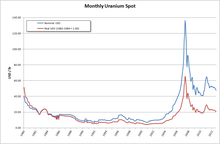
Monthly uranium spot price in US$ per pound. The 2007 price peak is clearly visible.[97]
In 2005, ten countries accounted for the majority of the world's concentrated uranium oxides: Canada (27.9%), Australia (22.8%), Kazakhstan (10.5%), Russia (8.0%), Namibia (7.5%), Niger (7.4%), Uzbekistan (5.5%), the United States (2.5%), Argentina (2.1%) and Ukraine (1.9%).[98] In 2008 Kazakhstan was forecast to increase production and become the world's largest supplier of uranium by 2009.[99][100] The prediction came true, and Kazakhstan does dominate the world's uranium market since 2010. In 2021, its share was 45.1%, followed by Namibia (11.9%), Canada (9.7%), Australia (8.7%), Uzbekistan (7.2%), Niger (4.7%), Russia (5.5%), China (3.9%), India (1.3%), Ukraine (0.9%), and South Africa (0.8%), with a world total production of 48,332 tonnes.[81] Most of uranium was produced not by conventional underground mining of ores (29% of production), but by in situ leaching (66%).[81][101]
In the late 1960s, UN geologists also discovered major uranium deposits and other rare mineral reserves in Somalia. The find was the largest of its kind, with industry experts estimating the deposits at over 25% of the world's then known uranium reserves of 800,000 tons.[102]
The ultimate available supply is believed to be sufficient for at least the next 85 years,[87] although some studies indicate underinvestment in the late twentieth century may produce supply problems in the 21st century.[103] Uranium deposits seem to be log-normal distributed. There is a 300-fold increase in the amount of uranium recoverable for each tenfold decrease in ore grade.[104] In other words, there is little high grade ore and proportionately much more low grade ore available.
Calcined uranium yellowcake, as produced in many large mills, contains a distribution of uranium oxidation species in various forms ranging from most oxidized to least oxidized. Particles with short residence times in a calciner will generally be less oxidized than those with long retention times or particles recovered in the stack scrubber. Uranium content is usually referenced to U 3O 8, which dates to the days of the Manhattan Project when U 3O 8 was used as an analytical chemistry reporting standard.[105]
Phase relationships in the uranium-oxygen system are complex. The most important oxidation states of uranium are uranium(IV) and uranium(VI), and their two corresponding oxides are, respectively, uranium dioxide (UO 2) and uranium trioxide (UO 3).[106] Other uranium oxides such as uranium monoxide (UO), diuranium pentoxide (U 2O 5), and uranium peroxide (UO 4·2H 2O) also exist.
The most common forms of uranium oxide are triuranium octoxide (U 3O 8) and UO 2.[107] Both oxide forms are solids that have low solubility in water and are relatively stable over a wide range of environmental conditions. Triuranium octoxide is (depending on conditions) the most stable compound of uranium and is the form most commonly found in nature. Uranium dioxide is the form in which uranium is most commonly used as a nuclear reactor fuel.[107] At ambient temperatures, UO 2 will gradually convert to U 3O 8. Because of their stability, uranium oxides are generally considered the preferred chemical form for storage or disposal.[107]
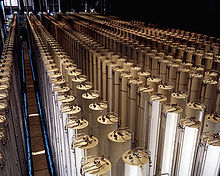
Cascades of gas centrifuges are used to enrich uranium ore to concentrate its fissionable isotopes.
In nature, uranium is found as uranium-238 (99.2742%) and uranium-235 (0.7204%). Isotope separation concentrates (enriches) the fissile uranium-235 for nuclear weapons and most nuclear power plants, except for gas cooled reactors and pressurised heavy water reactors. Most neutrons released by a fissioning atom of uranium-235 must impact other uranium-235 atoms to sustain the nuclear chain reaction. The concentration and amount of uranium-235 needed to achieve this is called a 'critical mass'.
To be considered 'enriched', the uranium-235 fraction should be between 3% and 5%.[125] This process produces huge quantities of uranium that is depleted of uranium-235 and with a correspondingly increased fraction of uranium-238, called depleted uranium or 'DU'. To be considered 'depleted', the uranium-235 isotope concentration should be no more than 0.3%.[126] The price of uranium has risen since 2001, so enrichment tailings containing more than 0.35% uranium-235 are being considered for re-enrichment, driving the price of depleted uranium hexafluoride above $130 per kilogram in July 2007 from $5 in 2001.[126]
The gas centrifuge process, where gaseous uranium hexafluoride (UF 6) is separated by the difference in molecular weight between 235UF6 and 238UF6 using high-speed centrifuges, is the cheapest and leading enrichment process.[37] The gaseous diffusion process had been the leading method for enrichment and was used in the Manhattan Project. In this process, uranium hexafluoride is repeatedly diffused through a silver-zinc membrane, and the different isotopes of uranium are separated by diffusion rate (since uranium-238 is heavier it diffuses slightly slower than uranium-235).[37] The molecular laser isotope separation method employs a laser beam of precise energy to sever the bond between uranium-235 and fluorine. This leaves uranium-238 bonded to fluorine and allows uranium-235 metal to precipitate from the solution.[7] An alternative laser method of enrichment is known as atomic vapor laser isotope separation (AVLIS) and employs visible tunable lasers such as dye lasers.[127] Another method used is liquid thermal diffusion.[9]
The only significant deviation from the 235U to 238U ratio in any known natural samples occurs in Oklo, Gabon, where natural nuclear fission reactors consumed some of the 235U some two billion years ago when the ratio of 235U to 238U was more akin to that of low enriched uranium allowing regular ("light") water to act as a neutron moderator akin to the process in humanmade light water reactors. The existence of such natural fission reactors which had been theoretically predicted beforehand was proven as the slight deviation of 235U concentration from the expected values were discovered during uranium enrichment in France. Subsequent investigations to rule out any nefarious human action (such as stealing of 235U) confirmed the theory by finding isotope ratios of common fission products (or rather their stable daughter nuclides) in line with the values expected for fission but deviating from the values expected for non-fission derived samples of those elements.
Uranium, like all elements with an atomic number greater than 82, has no stable isotopes. All isotopes of uranium are radioactive because the strong nuclear force does not prevail over electromagnetic repulsion in nuclides containing more than 82 protons.[112] Nevertheless, the two most stable isotopes, uranium-238 and uranium-235, have half-lives long enough to occur in nature as primordial radionuclides, with measurable quantities having survived since the formation of the Earth.[113] These two nuclides, along with thorium-232, are the only confirmed primordial nuclides heavier than nearly-stable bismuth-209.[4][114]
Natural uranium consists of three major isotopes: uranium-238 (99.28% natural abundance), uranium-235 (0.71%), and uranium-234 (0.0054%). There are also four other trace isotopes: uranium-239, which is formed when 238U undergoes spontaneous fission, releasing neutrons that are captured by another 238U atom; uranium-237, which is formed when 238U captures a neutron but emits two more, which then decays to neptunium-237; uranium-236, which occurs in trace quantities due to neutron capture on 235U and as a decay product of plutonium-244;[114] and finally, uranium-233, which is formed in the decay chain of neptunium-237.
Uranium-238 is the most stable isotope of uranium, with a half-life of about 4.463×10⁹ years,[4] roughly the age of the Earth. Uranium-238 is predominantly an alpha emitter, decaying to thorium-234. It ultimately decays through the uranium series, which has 18 members, into lead-206.[15] Uranium-238 is not fissile, but is a fertile isotope, because after neutron activation it can be converted to plutonium-239, another fissile isotope. Indeed, the 238U nucleus can absorb one neutron to produce the radioactive isotope uranium-239. 239U decays by beta emission to neptunium-239, also a beta-emitter, that decays in its turn, within a few days into plutonium-239. 239Pu was used as fissile material in the first atomic bomb detonated in the "Trinity test" on 15 July 1945 in New Mexico.[40]
Uranium-235 has a half-life of about 7.04×10⁸ years; it is the next most stable uranium isotope after 238U and is also predominantly an alpha emitter, decaying to thorium-231.[4] Uranium-235 is important for both nuclear reactors and nuclear weapons, because it is the only uranium isotope existing in nature on Earth in any significant amount that is fissile. This means that it can be split into two or three fragments (fission products) by thermal neutrons.[15] The decay chain of 235U, which is called the actinium series, has 15 members and eventually decays into lead-207.[15] The constant rates of decay in these decay series makes the comparison of the ratios of parent to daughter elements useful in radiometric dating.
Uranium-236 has a half-life of 2.342×10⁷ years[4] and is not found in significant quantities in nature. The half-life of uranium-236 is too short for it to be primordial, though it has been identified as an extinct progenitor of its alpha decay daughter, thorium-232.[67] Uranium-236 occurs in spent nuclear fuel when neutron capture on 235U does not induce fission, or as a decay product of plutonium-240. Uranium-236 is not fertile, as three more neutron captures are required to produce fissile 239Pu, and is not itself fissile; as such, it is considered long-lived radioactive waste.[117]
Uranium-234 is a member of the uranium series and occurs in equilibrium with its progenitor, 238U; it undergoes alpha decay with a half-life of 245,500 years[4] and decays to lead-206 through a series of relatively short-lived isotopes.
Uranium-233 undergoes alpha decay with a half-life of 160,000 years and, like 235U, is fissile.[10] It can be bred from thorium-232 via neutron bombardment, usually in a nuclear reactor; this process is known as the thorium fuel cycle. Owing to the fissility of 233U and the greater natural abundance of thorium (three times that of uranium),[118]233U has been investigated for use as nuclear fuel as a possible alternative to 235U and 239Pu,[119] though is not in widespread use as of 2022.[118] The decay chain of uranium-233 forms part of the neptunium series and ends at nearly-stable bismuth-209 (half-life 2.01×10¹⁹ years)[4] and stable thallium-205.
Uranium-232 is an alpha emitter with a half-life of 68.9 years.[4] This isotope is produced as a byproduct in production of 233U and is considered a nuisance, as it is not fissile and decays through short-lived alpha and gamma emitters such as 208Tl.[119] It is also expected that thorium-232 should be able to undergo double beta decay, which would produce uranium-232, but this has not yet been observed experimentally.[4]
All isotopes from 232U to 236U inclusive have minor cluster decay branches (less than 10−10%), and all these bar 233U, in addition to 238U, have minor spontaneous fission branches;[4] the greatest branching ratio for spontaneous fission is about 5×10⁻⁵% for 238U, or about one in every two million decays.[120] The shorter-lived trace isotopes 237U and 239U exclusively undergo beta decay, with respective half-lives of 6.752 days and 23.45 minutes.[4]
In total, 28 isotopes of uranium have been identified, ranging in mass number from 214[121] to 242, with the exception of 220.[4][122] Among the uranium isotopes not found in natural samples or nuclear fuel, the longest-lived is 230U, an alpha emitter with a half-life of 20.23 days.[4] This isotope has been considered for use in targeted alpha-particle therapy (TAT).[123] All other isotopes have half-lives shorter than one hour, except for 231U (half-life 4.2 days) and 240U (half-life 14.1 hours).[4] The shortest-lived known isotope is 221U, with a half-life of 660 nanoseconds, and it is expected that the hitherto unknown 220U has an even shorter half-life.[124] The proton-rich isotopes lighter than 232U primarily undergo alpha decay, except for 229U and 231U, which decay to protactinium isotopes via positron emission and electron capture, respectively; the neutron-rich 240U and 242U undergo beta decay to form neptunium isotopes.[4]
Normal functioning of the kidney, brain, liver, heart, and other systems can be affected by uranium exposure, because, besides being weakly radioactive, uranium is a toxic metal.[31][136][137] Uranium is also a reproductive toxicant.[138][139] Radiological effects are generally local because alpha radiation, the primary form of 238U decay, has a very short range, and will not penetrate skin. Alpha radiation from inhaled uranium has been demonstrated to cause lung cancer in exposed nuclear workers.[140] While the CDC has published one study that no human cancer has been seen as a result of exposure to natural or depleted uranium,[141] exposure to uranium and its decay products, especially radon, is a significant health threat.[142] Exposure to strontium-90, iodine-131, and other fission products is unrelated to uranium exposure, but may result from medical procedures or exposure to spent reactor fuel or fallout from nuclear weapons.[143]
Although accidental inhalation exposure to a high concentration of uranium hexafluoride has resulted in human fatalities, those deaths were associated with the generation of highly toxic hydrofluoric acid and uranyl fluoride rather than with uranium itself.[144] Finely divided uranium metal presents a fire hazard because uranium is pyrophoric; small grains will ignite spontaneously in air at room temperature.[10]
Uranium metal is commonly handled with gloves as a sufficient precaution.[145] Uranium concentrate is handled and contained so as to ensure that people do not inhale or ingest it.
A person can be exposed to uranium (or its radioactive daughters, such as radon) by inhaling dust in air or by ingesting contaminated water and food. The amount of uranium in air is usually very small; however, people who work in factories that process phosphatefertilizers, live near government facilities that made or tested nuclear weapons, live or work near a modern battlefield where depleted uranium weapons have been used,[8] or live or work near a coal-fired power plant, facilities that mine or process uranium ore, or enrich uranium for reactor fuel, may have increased exposure to uranium.[128][129] Houses or structures that are over uranium deposits (either natural or man-made slag deposits) may have an increased incidence of exposure to radon gas. The Occupational Safety and Health Administration (OSHA) has set the permissible exposure limit for uranium exposure in the workplace as 0.25 mg/m3 over an 8-hour workday. The National Institute for Occupational Safety and Health (NIOSH) has set a recommended exposure limit (REL) of 0.2 mg/m3 over an 8-hour workday and a short-term limit of 0.6 mg/m3. At levels of 10 mg/m3, uranium is immediately dangerous to life and health.[130]
Most ingested uranium is excreted during digestion. Only 0.5% is absorbed when insoluble forms of uranium, such as its oxide, are ingested, whereas absorption of the more soluble uranyl ion can be up to 5%.[31] However, soluble uranium compounds tend to quickly pass through the body, whereas insoluble uranium compounds, especially when inhaled by way of dust into the lungs, pose a more serious exposure hazard. After entering the bloodstream, the absorbed uranium tends to bioaccumulate and stay for many years in bone tissue because of uranium's affinity for phosphates.[31] Incorporated uranium becomes uranyl ions, which accumulate in bone, liver, kidney, and reproductive tissues.[131]
Radiological and chemical toxicity of uranium combine by the fact that elements of high atomic number Z like uranium exhibit phantom or secondary radiotoxicity though absorption of natural background gamma and X-rays and re-emission of photoelectrons, which in combination with the high affinity of uranium to the phosphate moiety of the DNA cause an increasing numbers of single and double strand DNA breaks.[132]
Uranium is not absorbed through the skin, and alpha particles released by uranium cannot penetrate the skin.[28]
Uranium can be decontaminated from steel surfaces[133] and aquifers.
Ukraine has some of the largest lithium and titanium reserves in Europe, as well as being one of the largest suppliers of grain and corn to the rest of the world.
Ukraine has the second-largest natural gas reserves in Europe. Ores such as iron, titanium, and non-metallic raw materials are some of the country's major exports, and so are iron ore, corn, semi-finished iron, and seed oils.
Guinea accounts for 24% of global production of bauxite. Exports increased by 4% in 2022 over 2021, with the highest share being exported to China.
The Republic of Guinea was the world’s second-largest producer of bauxite in 2022, with output up by 4% on 2021. And it's expected to rise even more over the next few years.
DRC is home to the world’s largest reserves of cobalt (51% of known reserves) and significant quantities of diamonds, gold, and copper.
The Democratic Republic of the Congo is extremely rich in precious minerals, with an estimated US$24 trillion in untapped deposits of raw minerals in the country.
Iran's natural resources are worth an estimated US$27.3 trillion. As well as being the fifth largest crude oil producer in OPEC, it was the world's third-largest natural gas producer in 2020.
Iraq is the second-largest crude oil producer in OPEC (Organization of the Petroleum Exporting Countries), while being the world’s fifth-largest holder of proven crude oil reserves.
Iraq's desert terrain holds petroleum, natural gas, phosphates, and sulfur that amount to US$15.9 trillion in natural resources.
Coal, chromium, copper, iron ore, lead, manganese, zinc, and sulfur are also found in Iran.
Saudi Arabia's other natural resources include natural gas, copper, feldspar, phosphate, silver, sulfur, tungsten, and zinc.
It has US$34.4 trillion worth of natural resources—notably oil. Saudi Arabia has been a leading exporter ever since oil was discovered there in 1938.
Venezuela has the 10th-largest reserves of natural gas in the world, as well as being rich in iron ore, gold, bauxite, hydropower, and diamonds.
Venezuela has natural resources estimated at US$14.3 trillion that include iron, natural gas, and oil. In 2020, it had the largest proven oil reserves on earth.
The Philippines is a world-leading producer of nickel. It also produces a significant amount of gold and copper, with copper being the country’s primary mineral.
The Philippines is the fifth most mineralized country in the world, with an estimated US$1 trillion in untapped reserves of copper, gold, nickel, zinc, and silver. The Philippines currently exports iron ore, chromium, zinc and silver, and produces some oil and gas.
Brazil's resources are worth an estimated US$21.8 trillion. The country also has the capacity for immense hydroelectric power production.
Brazil's resources include gold, iron, oil, and uranium, while its mining industry is focused on bauxite, platinum, copper, gold, iron, and tin.
Norway's natural resources include petroleum, natural gas, iron ore, copper, lead, zinc, titanium, pyrites, nickel, fish, timber, and hydropower.
Norway's natural resources include petroleum, natural gas, iron ore, copper, lead, zinc, titanium, pyrites, nickel, fish, timber, and hydropower.
The Kingdom of Norway has rich resources of oil, natural gas, hydroelectric power, forests, and minerals. It's also one of the largest exporters of seafood. Norway is the world’s 13th largest oil producer. In addition, Norway is the fifth largest natural gas producer and the third largest per capita.
Indonesia has a large, and in many cases unprospected, variety of mineral deposits. Mining accounts for roughly one-tenth of the country’s GDP. The country possesses a wealth of mineral resources, being ranked first for nickel, second for tin, fifth for gold, sixth for bauxite, sixth for coal, and seventh for copper.
Fossil fuels, including petroleum, natural gas, and coal, constitute a major source of revenue. Indonesia still has 68 unexplored oil and gas basins across the archipelago.
Copper, lead, nickel, and zinc and precious metals like gold, platinum, and silver are also found in Canada. It is home to commodities including industrial minerals, such as gypsum, limestone, rock salt, and potash, as well as energy minerals, such as coal and uranium.
Canada has an estimated US$33.2 trillion worth of natural resources, with the third-largest oil deposits after Venezuela and Saudi Arabia. Canada is also a leading producer of natural gas.
Turkey’s geology is complex and this is reflected in the diversity of its mineral deposits. Excluding petroleum and coal, there are 53 exploitable minerals and metals and 4,500 mineral deposits in Turkey.
Turkey is the leading steel producer in the Middle East. It's also a major producer and exporter of chromite and mines iron ore, coal, lignite, bauxite, and copper.
In global terms, South Africa holds the world's largest reported reserves of gold, platinum group metals, chrome ore and manganese ore, and the second-largest reserves of zirconium, vanadium, and titanium.
South Africa is rich in minerals. The country boasts diamonds and gold, alongside reserves of iron ore, platinum, manganese, chromium, copper, uranium, silver, beryllium, and titanium.
Peru has reserves of both oil and natural gas, and is one of the world's richest countries in terms of natural resources
Peru is one of the primary producers of mineral commodities in the world. It is Latin America's largest producer of gold, and the world's second-largest producer of copper, silver, and zinc.
Chile is the main copper producer in the world, supplying 29% of global numbers. The country also accounts for 22% of the world's production of lithium, making it the second-biggest producer in the world.
Other minerals mined in Botswana include nickel-copper, coal, soda ash, gold, silver, semi-precious stones, and granite. Botswana has reserves of untapped uranium, lead, and zinc that are yet to be exploited.
Botswana's mining industry continues to be one of the most lucrative in the world, especially diamond mining. The country is the world's leading producer of diamonds by value.
Mexico's mining history goes back 500 years. It is a major source of silver and gold. The country is among the world's largest producers of oil, silver, copper, gold, lead, zinc, natural gas, and wood.
Minerals like mercury, cadmium, antimony, manganese, iron, and coal are also found there. Sizable fiscal revenues are derived from the oil and gas sector.
Namibia has a long history of mineral mining. In 2023, it was announced that an estimated 11 billion barrels in oil reserves were found off the country's coast.
Namibia is one of the most important countries for diamond mining, both onshore and offshore. Namibia is also rich in natural resources including uranium, copper, zinc, lead, magnesium, cadmium, arsenic, pyrites, silver, and gold.
Kazakhstan is the world's largest uranium producer. The country also has extensive coal, gold, and manganese reserves. Kazakhstan ranks third for the production of titanium in the world, seventh for zinc and eighth for lead.
Deposits of over 72 different natural resources, including oil, gas, gold, coal, iron, uranium, manganese, bauxite, and chromite, are present in the Republic of Kazakhstan. Oil and gas comprise 97% of all natural resource state revenues.
India's major mineral resources include coal (fourth largest reserves in the world), iron ore, manganese ore, lithium ore (sixth largest reserve in the world as of 2023), mica, bauxite, chromite, natural gas, diamonds, limestone, and thorium. India's oil reserves currently serve 25% of the country's demand.
India has the potential to produce US$400-500 billion worth of oil and gas, gold, silver, iron ore, copper, coal, calcium, rock phosphate, and more thanks to its abundant reserves of these resources.
America has large copper, gold, oil, and natural gas deposits, as well as substantial lead, molybdenum, phosphates, rare earth elements, uranium, bauxite, iron, mercury, nickel, potash, silver, tungsten, zinc, petroleum, natural gas, timber, and arable land.
The estimated value of natural resources in the United States is US$45 trillion. Almost 90% of this figure are timber and coal. As of 2020, the US had the largest proven coal reserves in the world.
China possesses oil and natural gas, as well as gold, aluminum, and other minerals in immense amounts.
Natural resources in China are estimated to be worth US$23 trillion. Coal and rare earth minerals make up 90% of China's resources.
Australia's natural resources include coal, timber, copper, iron ore, gold, and uranium. The country is also the largest net exporter of coal, with 29% of global coal exports.
A large producer of oil and liquified natural gas, Australia's proven oil reserves measured 2.4 billion barrels at the end of 2021.
Russia is rich in resources including coal, oil, natural gas, gold, timber, and rare earth metals.
Russia also has the second-largest gold reserves at 6,800 tons, or more than 12% of the global total as of 2021.
Russia holds the world's largest proven natural gas reserves. At 1.32 quadrillion cubic feet, its supply accounts for nearly 20% of the global total as of 2020.